…down, down, down.
Alice was growing very bored and very sleepy. How long had she been "falling?" What will happen when she lands? With nothing much to do but think, Alice quickly realized that her absence will
leave all of her responsibilities to others. Her anxiety over the situation grows, and with no one else around, she
begins talking to herself as if it were a common thing to do in this situation.
Who knows how long she will be gone? What if no one remembers to give her cat her milk? And with the thought of being gone forever of course, now she is concerned. Can she trust that someone will take over for her? Sure, she’s only 7, but in Alice’s mind she is very important.
 Who will feed her cat? What if no
one does? Will she be okay? She misses Dinah and soon imagines she is talking with her. And it is
certainly not strange to be talking to a cat. “Dinah, my dear! I wish you were here with me!” But then again, maybe
it was a good thing Dinah stayed behind; there are no mice in the air (and mice her Dinah's favorite). She continued wondering out loud, as if Dinah were next to her.
Who will feed her cat? What if no
one does? Will she be okay? She misses Dinah and soon imagines she is talking with her. And it is
certainly not strange to be talking to a cat. “Dinah, my dear! I wish you were here with me!” But then again, maybe
it was a good thing Dinah stayed behind; there are no mice in the air (and mice her Dinah's favorite). She continued wondering out loud, as if Dinah were next to her. But maybe there could be bats. They’re mouse-like, right? Can Dinah even catch a bat? Wait…has her cat ever eaten a bat? Has any cat ever eaten a bat? Or, maybe, has a bat ever eaten a cat? As stated in the book …she couldn’t answer either question, so it didn’t matter which way she put it. All of this seemed like quite normal conversation to have with oneself. Or with a cat. “Now, Dinah, tell me the truth: did you ever eat a bat?” She was not sure if she expected an answer. It certainly would not surprise her.
And after she began to doze off,
she landed.
THUD. She’s knocked back into the
moment. She brushes herself off.
She looked around, and there he
was. The White Rabbit! The moment she catches a glimpse of
the creature with a waistcoat and pocket watch, he disappeared.

Alice wandered into a long corridor with dozens of
locked doors. And considering how things had been going so far, she knows she
will not be able to get through a single one. Of course. That would be too
easy. And she was right.
But then she sees a key, sitting on a 3-legged glass table that she swears was not there before. She hesitates, but gives it a try. The key is pointless; it does not open a single door. But determined to get out of the long hallway, she tried the key in every door again. And just like the glass table that seemed to appear while she was not looking, Alice finds an additional door behind a small curtain. She tried they key again, and to her surprise, it worked! Relieved, she unlocked the door. But again, as fate would have it, Alice cannot even fit her head through this door.
But then she sees a key, sitting on a 3-legged glass table that she swears was not there before. She hesitates, but gives it a try. The key is pointless; it does not open a single door. But determined to get out of the long hallway, she tried the key in every door again. And just like the glass table that seemed to appear while she was not looking, Alice finds an additional door behind a small curtain. She tried they key again, and to her surprise, it worked! Relieved, she unlocked the door. But again, as fate would have it, Alice cannot even fit her head through this door.
Peeking through the opening, Alice
could see what appears to be a beautiful English garden just like the ones she had
only heard about in books and only seen in paintings. And there it was, right
in front of her.
“…even if my head would go through, it would be of very little use without my shoulders. Oh, if only I could shut up like a telescope! I think I could, if only I knew how to begin.”
“…even if my head would go through, it would be of very little use without my shoulders. Oh, if only I could shut up like a telescope! I think I could, if only I knew how to begin.”
For Alice, the problem is not that the door is too small; it is that she is too big.

Hoping for another key to show up, Alice stands up, collects
herself, and heads back to the table. As stated in the book, “For, you
see, so many out-of-the-way things had happened lately, that Alice had begun to
think that very few things indeed were really impossible.”
This is when she finds a bottle on the table where the key
had once been, and it was labeled “Drink Me.”
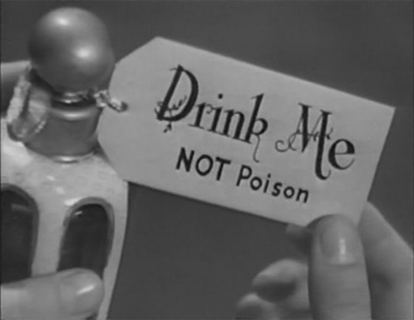 Despite the wave of optimism that had surged over her, Alice
wasn’t about to do that in any hurry.
Despite the wave of optimism that had surged over her, Alice
wasn’t about to do that in any hurry.
“If you drink much
from a bottle marked ‘poison,’ it is
almost certain to disagree with you, sooner or later.”
almost certain to disagree with you, sooner or later.”
But this bottle was not marked “poison,” and as soon as she
determined it was safe to drink, Alice found the taste to be so delightful that quickly finished off the whole bottle.
Alice liked to give herself good advice, even though she seldom ever followed it.